


Free 2-minute case check
Repeat repairs on your CR-V that the dealer cannot replicate? Send us the repair orders, and we will tell you honestly whether you have a claim.
Get a free case review | Call (213) 531-2056
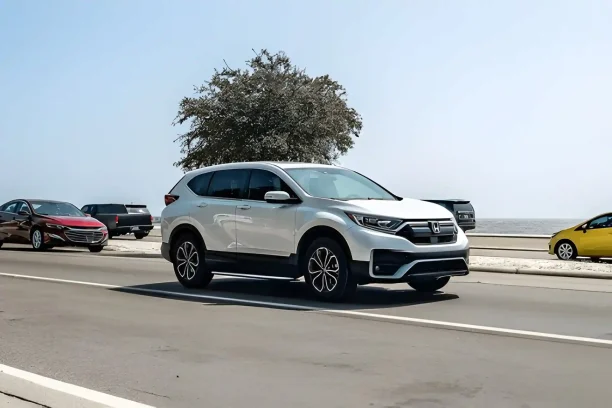
The 2021 CR-V fails in three clusters: the Honda Sensing camera and braking system, the front passenger airbag weight sensor, and the in-tank fuel pump. Everything else owners report sits well behind those three in volume and in federal attention.
Picture the most common version of the story. You are doing 55 in the right lane, road empty, coffee balanced in the cupholder. The CR-V decides a shadow under an overpass is a wall and stands on the brakes. The coffee does not survive. Neither does your confidence. You book a service appointment, the technician plugs in, finds nothing stored, and writes the three letters that end most of these visits: NPF, no problem found.
That loop is the reason this page exists. The defect is real enough that federal investigators are three years deep into it, and invisible enough that your dealer keeps sending you home.
Every 2021 CR-V uses a 1.5-liter turbocharged four-cylinder rated at 190 horsepower and 179 pound-feet, paired with a continuously variable transmission. Hybrid trims pair a 2.0-liter engine with two electric motors (Honda, 2021). Honda Sensing is standard on every trim, including the base LX, which matters because the biggest problem on this vehicle is a Honda Sensing problem.
Four safety recalls apply to the 2021 Honda CR-V as of this update. Each one is listed below with its NHTSA campaign number, so you can verify it yourself rather than taking anyone’s word for it.
| NHTSA campaign | Filed | What fails | Why it matters | Honda’s remedy |
| 26V332 | May 2026 | Front passenger seat weight sensor capacitor cracks after humidity exposure, wider VIN population | Airbags may deploy in a crash that should have suppressed them | Free seat weight sensor replacement, letters mailed July 6, 2026 |
| 24V064 | Jan 2024 | Same seat weight sensor, first wave | Same unintended deployment risk | Free sensor replacement, phased notification |
| 23V858 | Dec 2023 | In-tank fuel pump may fail | Engine stalls while driving | Free fuel pump module replacement |
| 21V900 | Nov 2021 | Second-row center seat belt automatic locking retractor deactivates improperly, fails FMVSS 208 | A child seat can sit unsecured while looking installed | Free replacement of the center seat belt assembly |
The May 2026 campaign is the one to act on. Honda expanded 24V064 because the supplier misjudged how many circuit boards used the substitute material, and the expansion swept in every 2017 to 2022 CR-V. Honda recorded 228 warranty claims tied to the defect and no injuries (NHTSA, 2026). If you already had the 2024 sensor recall performed, that does not automatically clear you, because the expanded campaign uses a different VIN list. Read the Part 573 safety recall report for 26V332 or run your VIN through the NHTSA recall lookup.
One recall that does NOT apply to you, despite the headlines: the June 2026 tire repair kit campaign covering more than a million vehicles is limited to 2023 through 2026 CR-V Hybrid, Accord Hybrid, and CR-V e: FCEV models. Your 2021 is not in it.
Honda’s Collision Mitigation Braking System, or CMBS, is the automatic emergency braking feature inside Honda Sensing. On 2017 to 2022 CR-V models, it has been reported to brake hard when nothing is in the road. Federal investigators call this inadvertent automatic emergency braking. Owners call it phantom braking.
The timeline is worth knowing, because it is the strongest evidence a 2021 owner has.
Buried in that federal document is the line that matters most in a warranty dispute. Honda suggested some owners may not have understood the system’s limitations. Investigators noted in response that many owners reported dealers could not reproduce the condition, or were told the behavior was normal CMBS operation (NHTSA, 2024).
If a service advisor has ever told you random hard braking is normal, that sentence is now in a federal case file. Print it. It converts your “no problem found” invoice from a dead end into a documented repair attempt. Our breakdown of the Honda collision mitigation system problem walks through the symptoms technicians look for, and the Honda phantom braking lawsuit page tracks the litigation side.

A cracked windshield on a 2021 CR-V is not a cosmetic problem, because the Honda Sensing camera looks through the glass directly behind the mirror. Owners have filed complaints with NHTSA describing cracks that appeared overnight with no impact, no debris, and no temperature swing, on vehicles with as little as 6,000 miles.
Two things follow from that, and dealers rarely explain either one.
An earlier class action over spontaneously cracking CR-V windshields, covering 2017 to 2019 models, was dismissed in February 2021 after the parties resolved it privately (ClassAction.org, 2021). Nothing was filed on behalf of 2021 owners. Warranty denial on glass is common, so get the crack origin documented in writing by the shop before anyone replaces anything.
Oil dilution means unburned gasoline seeps past the piston rings into the crankcase and thins the engine oil. On Honda’s 1.5-liter turbo, it shows up as a fuel smell at the dipstick, an oil level that climbs between changes, rough cold starts, and in the worst reported cases a stall.
Here is the part every other page skips. Honda’s remedies were tied to specific model years, and 2021 sits outside all of them.
| Remedy or case | Vehicles covered | Does a 2021 CR-V qualify |
| Honda powertrain warranty extension to 6 years, unlimited miles | 2017 to 2018 CR-V and 2016 to 2018 Civic with the 1.5 turbo | No |
| Wozniak settlement, approved 2020 | Same 2017 to 2018 CR-V population | No |
| Mackie v. American Honda, D. Minn. | 2019 to 2021 CR-V, 2019 to 2021 Civic, 2018 to 2021 Accord | Case dismissed, no benefits |
Mackie was the only class action that reached the 2021 CR-V, and the docket shows it was dismissed in November 2025 (CourtListener, case 0:22-cv-00736). No warranty extension replaced it. If your 2021 has fuel in the oil, nobody is coming with a group settlement check, and an individual claim is what is left.
Practical step while the paperwork sorts itself out. If you drive short trips in a cold state, shorten your oil change interval and keep every receipt. Ask the dealer to note the fuel odor complaint on the repair order in your words, not theirs. “Customer states gasoline smell from dipstick” is evidence. “Customer concerned about oil” is not.
P0847 is the generic OBD-II code for Transmission Fluid Pressure Sensor or Switch “B” Circuit Low. Search it and you will find a confident answer that is wrong for your vehicle: replace the third clutch pressure switch, part number 28600-RPC-013, roughly an hour of labor, problem solved.
That fix belongs to the 2005 to 2011 CR-V and its conventional five speed automatic, which used external clutch pressure switches and flashed a “D” light when one failed. Your 2021 CR-V uses a continuously variable transmission. It has no third clutch pressure switch to replace, so the part number that dominates the search results does not fit your car.
On a 2021 CR-V, a stored P0847 points toward the transmission fluid pressure sensor circuit, its wiring and connectors, or the CVT valve body. Those are diagnosis jobs, not parts-cannon jobs, and a shop that orders the old switch is telling you it has not looked up your transmission.
Do this before you authorize any transmission work
Ask for a printed scan report showing all stored and pending codes with freeze frame data. Ask which specific test the technician ran to reach the diagnosis. If the answer is a part number and no test, get a second opinion, and keep the first invoice either way.
Trim level changes your exposure less than most buyers expect, because Honda Sensing is standard across the entire 2021 range. Powertrain is the real dividing line.
| Trim | Powertrain | Recall exposure | What owners report most |
| LX and Special Edition | 1.5L turbo, CVT | All four recalls | Phantom braking, fuel odor in cold climates |
| EX and EX-L | 1.5L turbo, CVT | All four recalls | Phantom braking, infotainment freezes, windshield stress cracks |
| Touring | 1.5L turbo, CVT | All four recalls | Phantom braking, windshield cracks, camera recalibration issues |
| Hybrid EX, EX-L, Touring | 2.0L plus two electric motors | Seat sensor and seat belt recalls apply; the 2023 fuel pump campaign lists 2020 CR-V Hybrid | Loss of motive power reports, 12-volt system faults |
Worth saying plainly, because fear-based content on this model year gets it wrong: the 2021 CR-V is not a catastrophe. Consumer Reports rates it more reliable than the average vehicle from the same model year (Consumer Reports, 2026). Most 2021 CR-V owners will never file a complaint. The ones who do tend to file about the same three things, and those three things are the ones documented above.
If you have been searching for a class action to join, stop searching. Every active or recent Honda case that touches this hardware excludes the 2021 CR-V, and knowing that saves you months.
That leaves two doors open. The open federal investigation, which could still produce a recall and free repair. And an individual claim under your state lemon law or the federal Magnuson-Moss Warranty Act, which does not require anyone else to sue first.
Most 2021 CR-V factory coverage has expired, and pretending otherwise helps nobody. Honda’s new vehicle limited warranty runs 3 years or 36,000 miles, and the powertrain warranty runs 5 years or 60,000 miles, so both are gone or nearly gone on a vehicle delivered in 2020 or 2021. Three things survive.
Cases are won on paper, not on frustration. Intermittent faults like phantom braking are the hardest to prove and the easiest to document badly, so treat every visit as evidence collection.

A vehicle generally qualifies when a defect substantially impairs its use, value, or safety, the manufacturer gets a reasonable number of repair attempts, and the defect survives them. Most states read a reasonable number as three or four attempts on the same problem, or roughly 30 cumulative days out of service, within the warranty period.
Unintended hard braking clears the safety impairment test comfortably. So does a stall in traffic. The fight is almost never about whether the defect is serious. It is about whether you can prove you reported it enough times. Thresholds and deadlines vary by state, so check your own rules, for example our California lemon law page, and if you want to estimate the money involved, the lemon law buyback calculator does the mileage offset math for you.
Attorney fees are usually not the obstacle people expect, because most lemon law statutes shift the manufacturer’s obligation to pay them. See how much lemon law attorneys cost for how that works.
Which vehicles Lemon My Vehicle can take right now
We currently accept 2022 and newer vehicles still covered by the manufacturer’s warranty. A 2021 Honda CR-V usually falls outside that range, so we may not be able to take the case.
Asking still costs nothing. A small number of exceptions apply, and if we cannot help, we will point you to the recall remedies and the state warranty rules that still protect you.
Get a free case review | Call (213) 531-2056
Four. Campaign 21V900 covers the second-row center seat belt retractor, 23V858 covers the in-tank fuel pump, 24V064 covers the front passenger seat weight sensor, and 26V332 expands that sensor recall to a larger VIN population in May 2026. All four are repaired free of charge regardless of the vehicle’s age or mileage.
Yes for most owners. Consumer Reports rates the 2021 CR-V above average for its model year (Consumer Reports, 2026). Reliability and defect risk are different questions, though, and the complaints that do get filed cluster tightly around Honda Sensing braking, the airbag seat sensor, and the fuel pump.
The most common explanation is inadvertent activation of the Collision Mitigation Braking System. NHTSA opened a preliminary evaluation in February 2022 and upgraded it to engineering analysis EA24002 in April 2024, covering roughly 3 million 2017 to 2022 CR-V and 2018 to 2022 Accord vehicles. Investigators logged 1,294 complaints, including 31 alleging a crash (NHTSA, 2024). No recall has been ordered yet.
Some owners report the symptoms, particularly in cold climates on short trips: a gasoline smell at the dipstick and an oil level that rises between changes. Honda’s warranty extension and the 2020 settlement covered only 2017 to 2018 CR-V models, and the later case that included 2019 to 2021 vehicles was dismissed in November 2025, so no group remedy currently reaches a 2021 CR-V.
P0847 means the transmission control module read a low voltage signal on the “B” transmission fluid pressure sensor circuit. On 2005 to 2011 CR-V models the usual cause is a failed third clutch pressure switch, but the 2021 CR-V uses a CVT and has no such switch. On a 2021, the code points to the pressure sensor circuit, its wiring, or the CVT valve body, and it needs a diagnosis rather than a guessed part.
Yes. Federal safety recall repairs never expire and do not depend on warranty status, mileage, or whether you are the original owner. Enter your VIN at NHTSA.gov/recalls or contact a Honda dealer. Check again even if you checked in 2025, because campaign 26V332 was filed in May 2026.
Not currently. The phantom braking class action ended in an April 2026 jury verdict for Honda and covered only 2017 to 2019 CR-V models. The oil dilution case that included 2019 to 2021 vehicles was dismissed. The June 2026 front camera lawsuit names the Odyssey, Civic, HR-V, Clarity, and Pilot, not the CR-V. An individual claim under state lemon law or the federal Magnuson-Moss Warranty Act does not require a class.
Run your VIN for open recalls, then book a dealer appointment and insist the complaint is written on the repair order in your own words. Capture a dashcam clip if you can. Keep every invoice, including the ones that say no problem found, because those are the documents that build a repeat repair record.
Past results do not guarantee a similar outcome. Every claim is decided on its own facts, its own repair history, and the law of the state where the vehicle was bought or leased. This article is general information, not legal advice.
 $26,534 $24,110 $23,345 $23,000 $22,195 $22,000 $21,586 $21,550 $20,183 $20,000 $20,000 $19,411 $18,000 $18,000 $17,000 $16,000
 Call (213) 531-2056